
SMILE LASIK in Seoul, planned around your eyes — not a package.
Flapless, keyhole vision correction performed by experienced ophthalmologists, with a full corneal work-up first and an English-speaking team from consultation to final check.
Medically reviewed by Dr. Dongju Yeom, M.D., Ph.D., ophthalmologist & founder
Last updated: November 2026
Why patients choose Gangnam Smile Eye Clinic
One small incision. No corneal flap.
SMILE (Small Incision Lenticule Extraction) uses a femtosecond laser to shape a thin, lens-shaped layer of tissue (a lenticule) inside the cornea. The surgeon removes it through a 2–4 mm opening. Because no flap is cut, more of the cornea's upper structure stays intact.
Map the cornea
Topography, thickness and tear-film tests decide whether SMILE is right for you — or whether LASEK or ICL is safer.
Laser shapes a lenticule
The femtosecond laser creates the lenticule inside the intact cornea in seconds per eye.
Removed through a keyhole
The lenticule is removed through a 2–4 mm incision, changing the cornea's curvature.
Checked the next day
Most patients see well enough for daily tasks within a day or two; we examine you the next morning.
SMILE isn't right for everyone. Here's how the options differ.
| SMILE / SMILE Pro | LASIK | LASEK / PRK | ICL | |
|---|---|---|---|---|
| Technique | Flapless, 2–4 mm keyhole | Corneal flap + excimer laser | Surface treatment, no flap | Implantable lens, no tissue removed |
| Typical recovery | 1–2 days | 1–2 days | 3–5 days of discomfort | 1–3 days |
| Often suited to | Myopia & astigmatism, active lifestyles | Myopia, hyperopia, astigmatism | Thinner corneas, contact sports | High prescriptions, thin corneas |
| Dry-eye tendency | Generally lower | Moderate | Moderate, early on | Low |
| Learn more | SMILE Pro | LASIK | LASEK · PRK | ICL |
You may be suited to SMILE if…
Only an in-person exam can confirm candidacy. If SMILE isn't safe for your eyes, we will tell you — and explain the alternatives.
Before your exam
Contact lenses temporarily change the shape of the cornea, which can distort measurements. Your coordinator will tell you how long to leave out soft, toric or hard (RGP / Ortho-K) lenses before your appointment.
Bring your current glasses and any previous eye records.
Dr. Dongju Yeom, M.D., Ph.D.
Founder & CEO, Gangnam Smile Eye Clinic. Personally leads the Vision Correction and Presbyopia & Cataract centers, and supports English- and Mongolian-speaking patients.
M.D., Inje University College of Medicine
Ph.D. in Medicine
Ophthalmology residency, Seoul Paik Hospital
Former Chief of Ophthalmology, Yeoncheon Medical Center
KOS · KSCRS · ESCRS (full member)
Equipment and protocols behind every result
SMILE Pro laser
Flapless femtosecond-laser vision correction for myopia and astigmatism, alongside LASIK and LASEK platforms so each eye gets the method that suits it.
Corneal diagnostics
Every patient has corneal topography, thickness measurement and tear-film evaluation before any procedure is recommended.
Operating & recovery suites
Dedicated surgery and recovery rooms, with sterile protocols from pre-op preparation to discharge.
SMILE LASIK cost in Korea
Typical SMILE prices at Gangnam clinics range from about ₩1.8–2.8 million for both eyes. Your exact price depends on your prescription and exam results, and we give it to you in writing — listing exactly what's included — before you decide.
Get a personal quote
Send your current prescription on WhatsApp and a coordinator will reply in English with the likely options and price range for your eyes.
Your SMILE trip to Seoul, step by step
Online consultation
Share your prescription on WhatsApp; a coordinator replies in English.
Full eye exam
Corneal mapping and a one-to-one consultation with your surgeon.
About 15 minutes
Both eyes are treated in one short session; you rest at your hotel afterwards.
Post-op check
We examine healing and confirm your eye-drop schedule.
Remote follow-up
Records in English for your local eye doctor; we stay reachable on WhatsApp.
What to expect after SMILE
What we discuss with every patient
All eye surgery carries risk. Your surgeon reviews these with you before you consent:
Dry eye — usually temporary; managed with drops.
Glare or halos at night — common early on, tends to fade.
Under- or over-correction — may need glasses or an enhancement.
Infection or inflammation — rare; prevented with post-op drops.
SMILE risks & side effects →Hear from real patients
Watch patients — including 2025 Archery World Cup team gold medalist An San — talk about their visit to Gangnam Smile Eye Clinic.
Questions patients ask most
Answers reviewed by Dr. Dongju Yeom, M.D., Ph.D. · November 2026
Is SMILE better than LASIK?
Neither is better for everyone. SMILE avoids a flap and tends to cause less dry eye; LASIK treats a wider range of prescriptions, including hyperopia. Your corneal exam decides.
How many days should I stay in Seoul?
It depends on the procedure and your next-day check. Your coordinator will suggest a plan after reviewing your prescription — see also our travel timing guide.
Does SMILE hurt?
Numbing drops are used, so most patients feel pressure rather than pain. Mild discomfort for a few hours afterwards is normal.
Can I fly home after surgery?
Usually, once your post-op check is clear. Your surgeon confirms this at the next-day visit.
Do you have English-speaking staff?
Yes — English-speaking coordinators and doctors, with Mongolian, Russian, Chinese, Japanese and other language support.
Everything to research before you decide
SMILE LASIK in Seoul
What is SMILE LASIK? SMILE procedure step by step SMILE LASIK cost in Korea Candidacy checklist Risks & side effects Recovery timelineChoosing a clinic
Compare SMILE clinics in Seoul SMILE LASIK clinics in Gangnam SMILE LASIK in Myeongdong Best SMILE LASIK clinics in Seoul International patient guideBook your free SMILE consultation
Message us your prescription and a coordinator will reply in English to arrange your exam.
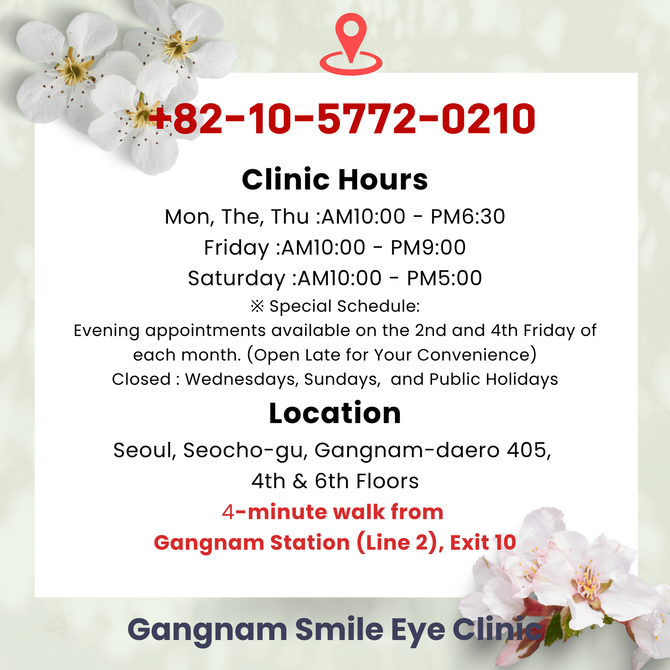
Tong-young Building, 405 Gangnam-daero, Seocho-gu, Seoul
1 minute from Gangnam Station Exit 10
Mon, Tue, Thu 10:00–18:30
Fri 10:00–21:00 (2nd & 4th Fri)
Sat 10:00–17:00
Closed Wed, Sun & public holidays
This page is for general information and does not replace a medical consultation. Results vary between individuals. Medical content reviewed by Dr. Dongju Yeom, M.D., Ph.D., ophthalmologist.